Unit 1
Consumption, resources, and the environment: What you need to know
Hello friends, family, and random people on the internet, and welcome to my blog! If you're thinking, Have I stumbled back into 2012? don't worry, this isn't a blog about Avril Lavigne or my travels to Disney World. This blog is a space for you to learn, think, and converse about the resources that we humans use and the impacts that the production and consumption of those resources have on our precious earth.
Now, before we can get into this discussion, you're going to want to know what sort of resources we're dealing with. First of all, we're talking about natural resources; that's the stuff that's naturally occurring in the environment, like coal, wood and water. There are two main types of natural resources, renewable and nonrenewable. Renewable resources are the ones that grow again fairly quickly-- like, within our lifetime-- or never run out, like corn that we can replant on the same land and sunlight that just keeps shining no matter how much we use it (Renewable and Nonrenewable Resources). There's also a specific subset of renewable resources called biorenewable resources, which come from living things, like wool and corn (Lesson 1). Renewable resources are our favorite because we don't have to worry about irreparably depleting them through human behavior and screwing over future generations. Then there are the nonrenewable resources, which are significantly trickier to deal with. This is the stuff like oil and copper that takes millions of years to regenerate or doesn't at all (Renewable and Nonrenewable Resources). Basically, once we run out, we're toast. But don't panic! There are ways to be economical with our resources, even the nonrenewable ones, and our capabilities of extracting resources are improving all the time.
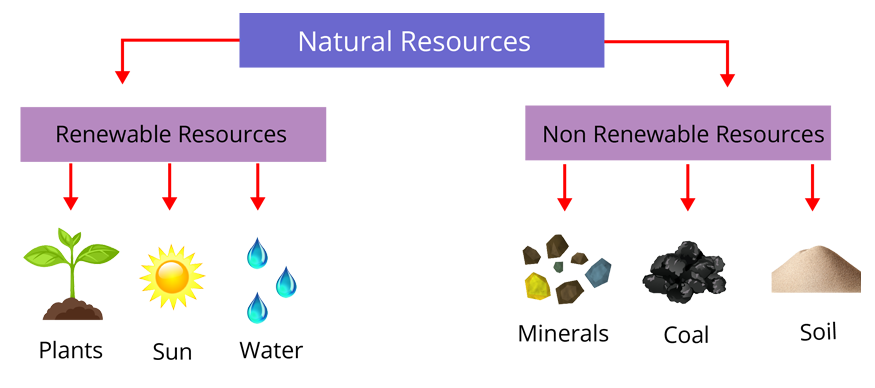
(Understanding Renewable And Non Renewable Resources)
Do you ever find yourself wondering just how long we have before we've used up all of our planet's resources and have to flee to Venus? I certainly do. I don't think we'd do well on Venus. Therefore, I say it's important to have a good idea of how long we've got before we run out of resources so that we can plan ahead by developing new technologies for extraction and alternatives to our favorite resources. Luckily, the world's environmental scientists and statisticians agree with me, and they've come up with this thing called the Reserves to Production Ratio. It goes like this: R is the proven reserves (the amount of the resource that we're sure we have), and P is how fast we're using the resource, so R/P = how much time we have until the resource is all gone (Lesson 2). Of course, the ratio is sort of hypothetical; the number is an estimate and can be inaccurate given potential changes in the reserve size and economic or technological factors (Energy Education - Reserves/production ratio). In the US, crude oil and natural gas proved reserves are increasing over time due to new discoveries and technologies as well as cost changes. US crude oil reserves have increased from 36,520 in 2013 to 46,422 in 2023, and US natural gas proved reserves have increased from 353,994 in 2013 to 603,615 in 2023 (EIA - Natural Gas). These increases in reserve size-- using the Reserves to Production Ratio-- tell us that the amount of time we have until we run out of these resources is increasing as time goes on. If things continue to progress in this direction, we won't be running out of nonrenewable resources any time soon. Yay!

(EIA - Natural Gas)
While this data and these reassuring graphs may make it easy for us to say, "We have resources for days, no need to worry!", it's still important to be conscious of our resource usage. Although we're finding new and better ways to extract nonrenewable resources from the earth, they are still finite, so our best solution is to come up with sustainable and renewable alternatives. Our planet will thank us for it, and so will the future generations of humanity.
Thanks for reading, and tune in next time to hear about the marvels of biomass production!
-------------------------------------------------------------------------------------------------------------------------------
Resources - in order of appearance
1. Smith, Sanford S. Renewable and Nonrenewable Resources, June 23, 2006, extension.psu.edu
2. Lesson 1: Introduction to Resources, BBE 1002, UMN
3. Understanding Renewable And Non Renewable Resources, vedantu.com
4. Lesson 2: Our Resources, Our Consumption, BBE 1002, UMN
5. J.M.K.C. Donev et al. Energy Education - Reserves/production ratio, 2024, energyeducation.ca
6. EIA - Natural Gas - U.S. Crude Oil and Natural Gas Proved Reserves, Year-end 2023, June 25, 2025, eia.gov


Comments
Post a Comment